
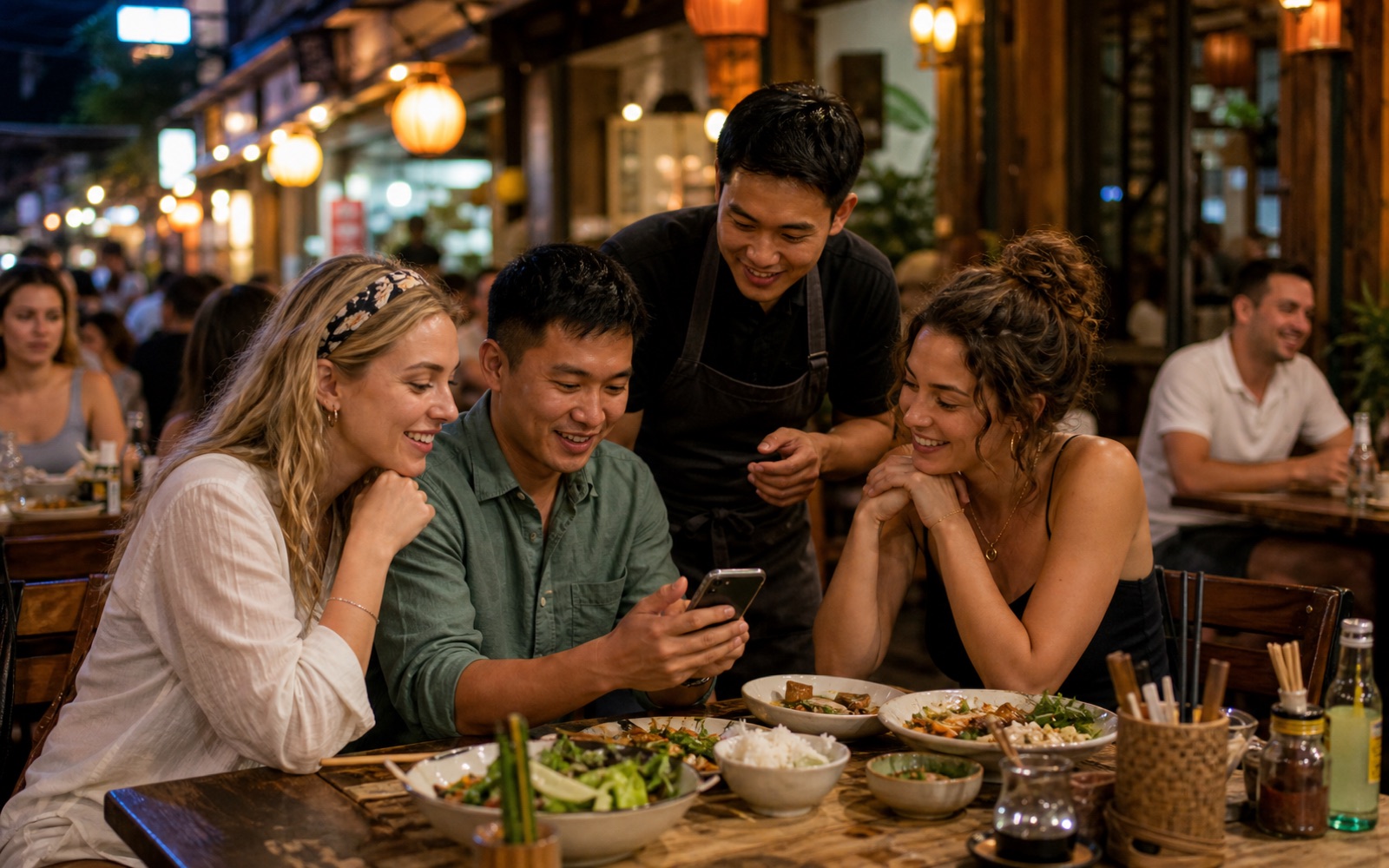
A table of four walks in. They speak Spanish. Your server speaks English and a bit of French. The ordering process takes 15 awkward minutes, involves a lot of pointing at the menu, two wrong dishes, and ends with a smaller order than the table would have placed if they'd felt comfortable. This happens in restaurants across the world, every service.
The traditional fix - multilingual printed menus - costs hundreds of pounds, goes out of date the moment you change a dish, and doesn't solve the most important problem: customers can't ask questions and get answers in their language.
The real cost of language barriers
Language friction affects restaurants in ways that don't show up on a single transaction:
- Smaller orders: Customers who can't easily navigate a menu default to whatever they can recognise. They order less, skip starters and desserts, and skip the wine.
- Order errors: Misunderstandings between customer and server lead to dishes being returned or remade - a direct cost to the kitchen and a memory that shapes the review they leave.
- Reduced repeat visits: A comfortable meal in a second language is memorable for the wrong reasons. Those guests are less likely to return or recommend your restaurant.
- Google review sentiment: "Staff didn't speak our language" and "menu was confusing" are among the most common complaints from international diners in tourist-area restaurants.
The bottom line: For a restaurant in a tourist area, 25 to 40% of covers on busy periods may not speak the language your staff and menu are optimised for. That's not a niche problem - it's a significant portion of your revenue at risk every service.
Why printed multilingual menus aren't enough
Most restaurants that try to address this print menus in two or three languages. This solves the browsing problem but not the conversation problem. Customers still can't:
- Ask what "confit" means in the context of your duck dish
- Request a substitution ("can I have the salmon without the sauce?")
- Find out about allergen information specific to a dish
- Ask what the chef recommends tonight
Those interactions - where a server answers a question with knowledge and warmth - are where restaurant revenue and reputation are made. They're also exactly what an AI ordering system trained on your menu can do, in any language, without any configuration.
How AI multilingual ordering works in practice
With Voitly, language handling is fully automatic. When a multilingual guest calls, the AI detects their language on the phone, answers in the caller's language without any configuration, and takes the order 24/7. QR table ordering is also included: when a guest scans the code and begins tapping or typing in their language, the AI detects it and responds in kind. The same menu, the same allergen data, the same upsell logic - delivered in the customer's preferred language.
You don't configure this. There's no "select your language" button. The AI simply meets the customer where they are.
Languages supported out of the box
Which restaurants benefit most
While any restaurant benefits from removing friction, the ROI is highest for:
- Tourist-area restaurants in coastal, city-centre, or landmark locations
- Airport and hotel restaurants serving international travellers as a default
- Cultural cuisine restaurants where international diaspora communities are regulars
- Event venues hosting international corporate groups or weddings
A note for domestic restaurants
Even restaurants with mostly local customers benefit from multilingual support for a different reason: accessibility. Customers from immigrant communities, families where parents don't speak the local language fluently, and elderly guests who never learned it - these are regular diners in most cities, and they rarely complain about language friction. They just don't come back.
The staff confidence benefit
There's an underappreciated benefit here for your team. Front-of-house staff who aren't confident in a customer's language often avoid the table. They take longer to check in, skip the upsell, and feel relieved when the table pays and leaves. That's not their fault - it's a structural problem.
When AI handles the order-taking for non-English speaking tables, your staff can engage on their own terms: bringing the food, checking satisfaction, adding a warm moment. The parts of the interaction they're good at. The pressure of the language barrier is removed.
Serve every customer in their language
Voitly supports 40+ languages automatically - no setup, no configuration. Try it free for 7 days.
Start free trial